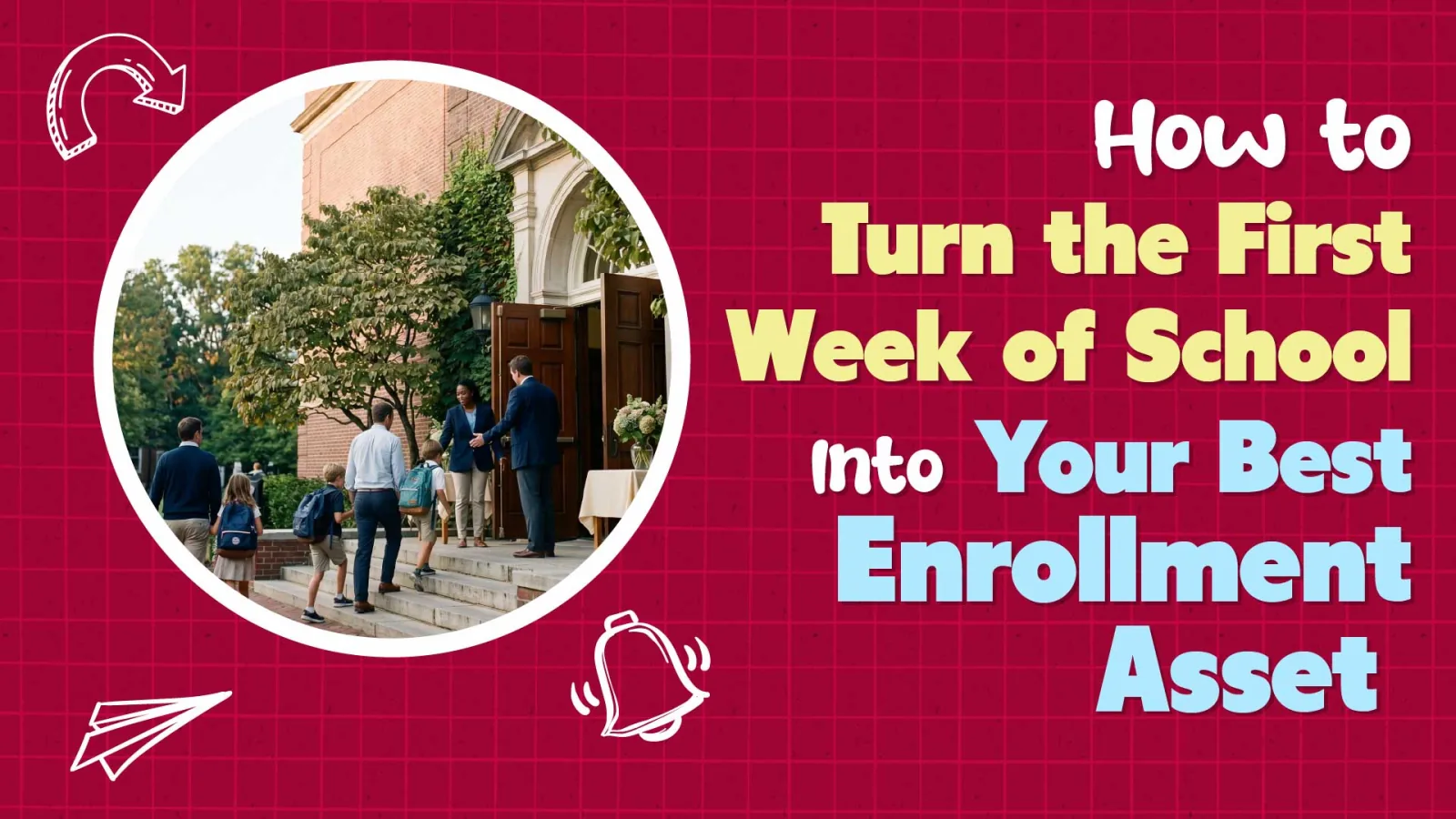
Most schools spend nine months and a five-figure budget convincing a family to enroll, then treat the first week those families walk through the door as a parking-lot logistics problem. Buses, badges, schedules, done. The marketing team, having handed off the "won" family, moves on to next year's funnel.
That is a mistake, and an expensive one. Welcome week marketing treats that first week as a planned campaign rather than a logistics drill, and it protects the families you just worked so hard to win. In their first weeks, those families quietly check every promise your admissions team made. At Cube Creative Design, we help private and independent schools treat enrollment as something that continues past the signed contract. Welcome week is the clearest example of why that matters. This post shows how a marketing director can plan the first week of school as a deliberate campaign. Done well, that campaign cuts early attrition, creates referral-ready families, and hands you a year's worth of real content. Think of it as the highest-return week on your calendar that nobody is managing.

Written By: Adam Bennett | August 07, 2026
Adam is the president and founder of Cube Creative Design and specializes in private school marketing. Since starting the business in 2005, he has created individual relationships with clients in Western North Carolina and across the United States. He places great value on the needs, expectations, and goals of the client.
You already know the first day of school is a big deal. The problem is that it lands in the same week you are checking in new families, chasing down forms, and putting out a dozen small fires before the first bell. Social media is the thing that quietly slips, right when it should be front and center.
That's a missed opportunity, and not a small one. The first day is the one moment all year when your whole community wants to post about your school at the same time. This first day of school social media swipe file gives you specific, ready-to-use ideas so you are not staring at a blank content calendar the night before. It is built for the person who runs marketing and admissions and the school's Instagram account, which at a lot of independent schools is the same person. If that's you, or you support marketing at one of the independent schools we work with, keep this open on your phone during that first week.

Written By: Hannah Kilpatrick | August 05, 2026
Hannah Kilpatrick Cube Creative DesignHannah Kilpatrick graduated from Western Carolina University in 2021 with a Bachelor of Science in Communication with a Minor in Marketing and a Concentration in Public Relations. She has been around social media since its creation. (Meaning, she was in the first grade when Facebook became available to the general public.) As our very own professional Gen-Z, Hannah is a whiz when it comes to social media creation and paid advertising.
Your inbox in late July looks like a to-do list someone else wrote. The head of school wants the fall numbers up. Two board members forwarded you a competitor's Instagram reel. Somewhere in a spreadsheet, last spring's open house leads are going cold. So you do what most marketing directors do under pressure: you pay to promote a Facebook post, refresh the homepage banner, and send an email blast, then hope something sticks. That scattered approach is exactly why a back-to-school campaign so often underperforms, and it is the gap this guide is built to close. At Cube Creative Design, we spend our days on private school marketing, and the schools that win the fall season are not the ones with the biggest budgets. They are the ones who treat the season as a single coordinated campaign instead of a pile of disconnected tactics.
This is a working playbook, not a definition. You already know what a campaign is. What you need is a framework you can hand to your team on the first Monday of summer and run without guessing. We will build it in five connected moves: set the calendar, coordinate the channels, segment the families, design the calls to action, and measure the result. Each move feeds the next. Skip one and the whole thing leaks.
Written By: Adam Bennett | August 03, 2026
Adam is the president and founder of Cube Creative Design and specializes in private school marketing. Since starting the business in 2005, he has created individual relationships with clients in Western North Carolina and across the United States. He places great value on the needs, expectations, and goals of the client.
Your alumni are the warmest audience your school will ever have, and most schools talk to them once a year, in the form of a giving envelope. That is the marketing equivalent of only calling your closest friends when you need to borrow money. It works for a while. Then it stops working, and nobody can say exactly when the relationship went cold.
Private school alumni engagement is the work of keeping that relationship warm on purpose, year after year, long after a graduate has stopped paying tuition. Done well, it pays a school back in three ways that matter to anyone in admissions and advancement. It brings referrals that feed the enrollment pipeline. It brings volunteers who show up. And it brings gifts that arrive without a guilt trip. We work with private and independent schools that have strong programs and loyal families, but treat their graduates as an afterthought. The pattern is almost always the same. The intent is there. The system is not.
This post lays out what an alumni engagement strategy actually involves for a mid-sized college-prep school. It covers why the payoff shows up in enrollment and not just the annual report. And it gives you a five-part framework you can start using before your next graduating class walks the stage. The numbers here come from independent school sources. Where a benchmark comes from higher education or a mixed survey, it is labeled as such, because your board will check.
Written By: Adam Bennett | July 27, 2026
Adam is the president and founder of Cube Creative Design and specializes in private school marketing. Since starting the business in 2005, he has created individual relationships with clients in Western North Carolina and across the United States. He places great value on the needs, expectations, and goals of the client.