Let's face it – summer program recruitment isn't what it used to be. Gone are the days when a few flyers and word-of-mouth could fill your classrooms during those critical summer months. In today's digital landscape, parents and students are bombarded with summer options from the moment the winter holidays end. Standing out requires strategy, precision, and yes, a bit of digital savvy.
Summer programs represent a significant revenue opportunity for private schools, but they're also fertile ground for student recruitment, community building, and brand enhancement. The right digital advertising approach doesn't just fill seats – it creates advocates, builds your school's reputation, and establishes a pipeline of potential full-time students.
But here's the uncomfortable truth many marketing directors don't want to admit: Most school summer program advertising campaigns are inefficient at best and wasteful at worst. Without a strategic approach to digital channels, even generous budgets can evaporate with little to show for the investment.
This guide will walk you through creating digital advertising campaigns that actually deliver results, regardless of your school type, budget constraints, or specific programmatic goals.
What Makes Summer Program Advertising Different?
How is marketing summer programs different from general school enrollment campaigns? Let me count the ways:
- Shorter decision timeline: Parents often make summer program decisions in weeks, not months or years.
- Different decision-makers: Sometimes, it's the student, not just the parents, especially for older age groups.
- Competitive landscape: You're competing not just with other schools but with camps, travel programs, and even summer jobs.
- Seasonal urgency: Your campaign has a firm end date when the program begins.
- Varied motivations: Parents might be looking for childcare solutions, academic enrichment, specialized training, or simply a way to keep their children engaged.
Understanding these differences is the first step toward creating campaigns that address the unique challenges of summer program recruitment.
Platform Strategy: Where Your Advertising Dollars Should Go
How Should You Approach Google Ads for Summer Programs?
Google Ads remains the cornerstone of most digital advertising strategies, and for good reason. When parents start searching for "summer programs near me" or "best STEM summer camps," you want your school to appear prominently. Here's how to structure an effective Google Ads campaign:
Search Campaign Structure
Create separate campaigns for:
- Brand terms (your school name + summer programs)
- General summer program terms
- Specialized program offerings (STEM, arts, sports, etc.)
- Geographic-specific searches
This separation allows for budget control and performance tracking across different objectives.
Keywords That Actually Convert
Focus on high-intent keywords that signal a readiness to enroll:
- "Register for summer programs [your city]"
- "Best [program type] summer programs"
- "[Your city] summer academic programs"
- "Summer programs for [specific age group]"
Examples:
- "Register for summer programs Louisville, KY"
- "Best theater summer programs in Los Angeles, CA"
- "Jacksonville, FL summer academic programs"
- "Summer programs for Middle Schooler’s in Philadelphia, PA"
Avoid broad, high-competition terms like "summer camps" without qualifiers, as they'll quickly deplete your budget with minimal returns.
Creating Ad Copy That Stands Out
Your ad copy needs to address parents' primary concerns:
- Highlight program dates and registration deadlines (create urgency)
- Mention age groups specifically
- Feature unique program benefits (small class sizes, specialized instruction, etc.)
- Include price if competitive or scholarships if available
Example:
STEM Summer Program | Ages 12-14 | [School Name]
Jun 10-Jul 15 | Expert Instructors | Register by May 1
Limited Space - Scholarships Available
Performance Max Campaigns
For schools with more substantial budgets, Google's Performance Max campaigns allow your ads to appear across Google's entire inventory, including Search, Display, YouTube, Gmail, and Maps. This AI-driven approach requires:
- High-quality images of your summer programs in action
- Multiple text assets
- A clear conversion goal (registration form completions)
- Patience during the learning phase (typically 2-3 weeks)
How Can Facebook Campaigns Drive Summer Program Enrollment?
Facebook remains uniquely powerful for summer program advertising because of its precise parental targeting options. Here's how to structure campaigns that convert:
Campaign Structure
Implement a three-tiered approach:
- Awareness: Introducing your program to parents in your target demographic
- Consideration: Retargeting those who engaged with more detailed program information
- Conversion: Final push with registration deadlines, limited space messaging, and direct calls-to-action
Ad Formats That Work for Summer Programs
- Carousel Ads: Showcase different aspects of your program (facilities, activities, instructors)
- Video Ads: Brief (30-60 second) glimpses of the summer experience
- Lead Generation Ads: Simplified forms to request program information
- Event Ads: For virtual or in-person information sessions
Creating Parent-Focused Ad Copy
Parents on Facebook respond to:
- Emotional appeals about their child's growth and development
- Social proof (testimonials from other parents)
- Clear program differentiators
- Straightforward logistics (dates, times, transportation options)
Remember, parents are often scrolling Facebook during brief breaks in their day – your ad needs to stop the scroll, deliver value, and prompt action within seconds.
How to Leverage Instagram for Summer Program Promotion
Instagram's visual nature makes it perfect for showcasing what makes your summer programs special. Here's how to make the most of it:
Content Strategy
- Feed Posts: High-quality images of previous summer programs with engaging captions
- Stories: Behind-the-scenes preparation, instructor introductions, facility tours
- Reels: Short, engaging clips that highlight exciting program activities
- IGTV: Longer-form content like parent testimonials or program overviews
Hashtag Strategy
Develop a three-tiered hashtag approach:
- Program-specific: #[YourSchool]SummerProgram #[YourSchool]2025
- Local: #[YourCity]SummerPrograms #[YourRegion]KidsActivities
- General: #SummerLearning #SummerEnrichment #PrivateSchoolSummer
Instagram Shopping
For schools with e-commerce capabilities, Instagram Shopping tags allow direct linking to registration pages, streamlining the enrollment process.
How Can TikTok Reach Gen Z and Their Parents?
While relatively new to educational marketing, TikTok offers unique opportunities to reach both students (especially for upper school programs) and their younger-demographic parents.
Content Approach
- Authentic, less polished content outperforms traditional marketing
- Student testimonials and experiences gain significant traction
- "Day in the life" perspectives from previous participants
- Educational content that showcases your program's unique approach
TikTok Advertising Options
- In-Feed Ads: Native-feeling videos that appear in users' For You Page
- Branded Hashtag Challenges: Create engagement around your summer program
- Branded Effects: Custom filters related to your program themes
Remember that success on TikTok relies more on authenticity and creativity than production value. This makes it particularly suitable for schools with limited production resources but enthusiastic students who can help create content.
How to Implement Display Network Advertising
Display advertising allows you to reach parents while they browse other websites, keeping your summer program top-of-mind throughout their decision process.
Placement Strategy
- Educational websites and parenting blogs
- Local news sites
- College planning resources (particularly for academic programs)
- Family lifestyle publications
Creative Requirements
- Multiple banner sizes (300x250, 728x90, 160x600 at minimum)
- Clear branding and program name
- Strong visual appeal with minimal text
- Compelling call-to-action
Programmatic Options
For schools with larger budgets, programmatic display advertising offers enhanced targeting capabilities:
- Contextual targeting (appearing on content related to education or child development)
- Behavioral targeting (reaching parents who have shown interest in educational enrichment)
- Look-alike modeling (finding users similar to your current parents)
How to Implement Effective Remarketing Tactics
Remarketing is often the highest-ROI component of summer program advertising. Parents may need multiple touchpoints before committing to registration.
Remarketing Audience Segments
Create separate remarketing audiences for:
- Website visitors who viewed program pages but didn't register
- Partial form completions
- Email subscribers who opened program announcements
- Previous year's participants
- Parents of current students who haven't registered
Cross-Platform Remarketing
Implement the Facebook Pixel, Google Remarketing Tag, and LinkedIn Insight Tag to create a comprehensive remarketing ecosystem that follows parents across their digital journey.
Frequency Capping
To avoid ad fatigue, implement frequency caps:
- Display remarketing: 3-4 impressions per day
- Social remarketing: 2 impressions per day
- Search remarketing: No cap (intent-based)
Campaign Elements: Crafting Materials That Convert
What Makes Effective Ad Copy for Summer Programs?
Ad copy for summer programs must balance emotional appeal with practical information. The most effective approach includes:
Core Components
- Unique Value Proposition: What makes your program different from the dozens of others parents are considering?
- Specific Benefits: Academic advancement, social skills development, specialized training
- Logistics: Dates, age ranges, daily schedules
- Social Proof: Mentions of waiting lists, limited spaces, or parent testimonials
- Clear Call-to-Action: What exact step should parents take next?
Ad Copy Templates by Platform
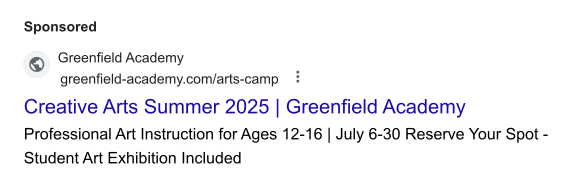
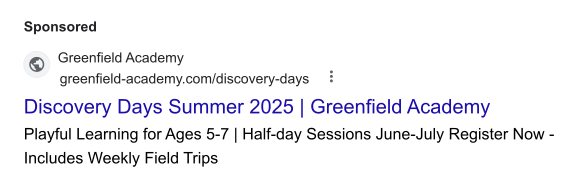
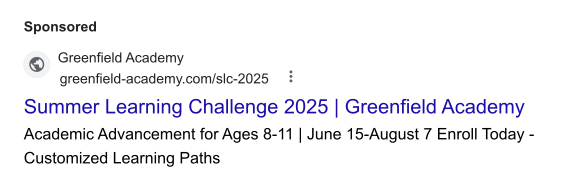
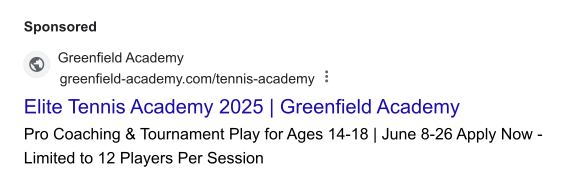
Google Search:
[Program Name] Summer 2025 | [School Name]
[Key Benefit] for Ages [X-Y] | [Dates]
[Call-to-Action] - [Unique Feature]
Google Search:
[Program Name] Summer 2025 | [School Name]
[Key Benefit] for Ages [X-Y] | [Dates]
[Call-to-Action] - [Unique Feature]


Facebook/Instagram:
Give your child the gift of [benefit] this summer.
[School Name]'s [Program Name] offers [unique features].
Ages [X-Y]. [Dates]. [Location].
Limited spaces available - register by [date].
Give your curious 10-13 year old the ultimate summer adventure!
STEM Explorer Summer 2025 at Greenfield Academy combines hands-on science experiments with real-world coding projects. June 15-July 10.
Our PhD instructors keep classes small to ensure personalized attention for every young scientist.
Don't miss out - registration closes May 1st!
greenfield-academy.org/stem-camp
Display/Remarketing:
[Question addressing parent pain point]
[School Name] Summer Programs
[Key Benefit] | [Dates] | Register Now
What Visual Elements Drive Engagement?
Visual components are crucial for summer program advertising. Parents need to envision their children in your program.
Photography Requirements
Effective summer program advertising requires:
- Authentic images of actual programs (stock photos are immediately apparent)
- Diverse representation of students
- Active, engaged learning moments
- Safe, appealing facilities
- Smiling, enthusiastic participants
Video Content Guidelines
Video increasingly drives enrollment decisions. Prioritize:
- Short (30-60 second) highlight reels
- Student testimonials from previous years
- Brief day-in-the-life sequences
- Faculty introductions
- Facility tours
Visual Brand Consistency
Maintain consistent visual branding across all platforms while adapting to platform-specific requirements:
- Instagram: Square and vertical formats, vibrant colors
- Facebook: Multiple format options with prominent school branding
- Google Display: Clean, uncluttered designs with clear text
- TikTok: Authentic, less produced aesthetic
How to Create Landing Pages That Convert
Your advertising is only as effective as the landing page it leads to. Summer program landing pages should be:
Design Elements
- Mobile-optimized (over 70% of parents will first view on mobile)
- Fast-loading (under 3 seconds)
- Singularly focused on one program or program category
- Designed with a clear visual hierarchy leading to registration
Content Components
Effective landing pages include:
- Hero section with compelling imagery and immediate value proposition
- Concise program description (bullet points preferred)
- Specific dates, times, ages, and pricing information
- Social proof (testimonials, enrollment statistics, faculty credentials)
- FAQ section addressing common concerns
- Clear, prominent call-to-action buttons
- Simplified registration process (minimize form fields)
A/B Testing Elements
Continuously test:
- Headline variations
- Image selection
- Call-to-action button copy and color
- Form length and field arrangement
- Testimonial placement
Even small optimizations can significantly impact conversion rates—an improvement in landing page performance can mean dozens of additional enrollments.
How to Implement Conversion Tracking
Without proper conversion tracking, you're essentially advertising in the dark.
Essential Conversion Points
Track these key actions:
- Information request form completions
- Brochure or schedule downloads
- Registration form starts
- Registration form completions
- Phone calls from ads
- Virtual tour signups
Cross-Platform Attribution
Implement these tracking elements:
- Google Analytics 4 with enhanced measurement
- Google Ads conversion tracking
- Facebook Pixel with custom conversions
- UTM parameter strategy for email and organic traffic
Conversion Value Assignment
Assign approximate values to different conversion types:
- Information request: $X (based on historical conversion rate to enrollment)
- Registration: $Y (average program value)
This allows for ROAS (Return on Ad Spend) calculation across platforms and campaigns.
Targeting Options: Finding the Right Families
How to Set Geographic Parameters
Geographic targeting strategy varies based on program type and school location:
Day Programs
- Primary radius: 5-15 miles (urban), 15-30 miles (suburban)
- Secondary radius: Commuting corridors with modified bid adjustments
- Exclude areas with logistical barriers (bridges, tunnels) that create psychological distance
Residential Programs
- Primary targets: Major metropolitan areas within 200-300 miles
- Secondary targets: National and international markets for specialized programs
- Consider geotargeting based on household income data
Location Extension Strategy
Implement Google location extensions to:
- Highlight proximity for nearby searches
- Provide directions
- Feature phone numbers for immediate inquiries
Remember that perception of distance is often a bigger barrier than actual distance—emphasize convenience and transportation options in ad copy.
How to Target By Age Group
Different age groups require distinct marketing approaches:
Elementary (K-5) Programs
- Primary decision-makers: Parents
- Key concerns: Safety, supervision, structured activities
- Targeting: Parents of children ages 5-11
- Platforms: Facebook, Instagram, Google Search
Middle School (6-8) Programs
- Decision-makers: Parents with student input
- Key concerns: Age-appropriate activities, developmental benefits
- Targeting: Parents of pre-teens, interest-based targeting around academic or specialized topics
- Platforms: Facebook, Instagram, Google Search, YouTube
High School (9-12) Programs
- Decision-makers: Joint parent/student or student-led
- Key concerns: College preparation, skill development, resume building
- Targeting: Both parents and students
- Platforms: Google Search, Instagram, TikTok, YouTube, Snapchat
Each campaign should speak directly to the age-specific benefits and concerns while using imagery that accurately represents the target age group.
How to Target Parent Demographics
Effective parent targeting goes beyond basic demographics:
Demographic Targeting Options
- Parents with children in specific age ranges
- Education level (typically bachelor's degree or higher correlates with private school interest)
- Household income thresholds
- Homeownership status
- Professional categories
Behavioral Targeting
Target parents who have demonstrated interest in:
- Educational enrichment
- Child development
- Specific program areas (STEM, arts, athletics)
- Private education
- Competitive college admissions
Life Event Targeting
Facebook and Google allow targeting around life events relevant to summer program decisions:
- Recent moves to the area
- Child reaching school milestones
- Job changes (particularly relevant for day programs)
How to Use Interest Targeting
Interest targeting allows you to reach parents based on their demonstrated preferences:
Program-Specific Interests
- Academic programs: Target interests in educational content, learning activities
- Arts programs: Target interests in visual arts, performing arts, creative activities
- Sports programs: Target interests in specific sports, athletics, physical fitness
- Specialty programs: Target niche interests related to program focus
Competitor Interest Targeting
Target parents who have shown interest in:
- Similar programs in your area
- National programs in your specialty
- Private schools and educational institutions
Affinity Audience Strategy
Google's affinity audiences and Facebook's interest categories allow targeting parents who match profiles like:
- Education Enthusiasts
- Lifelong Learners
- Parenting Influencers
- Academic Competitors
How to Build Effective Lookalike Audiences
Lookalike audiences leverage your existing parent community to find similar prospective families:
Seed Audience Sources
Create lookalike audiences based on:
- Previous summer program participants
- Current school families
- Email newsletter subscribers with high engagement
- Website visitors who completed high-value actions
Lookalike Expansion Strategy
Start with narrow lookalike audiences (1% similarity) for higher-cost programs, then expand to broader audiences (3-5% similarity) as budgets allow.
Platform-Specific Approaches
- Facebook: Create multiple lookalike audiences from different seed sources
- Google: Use Similar Audiences in combination with remarketing
- TikTok: Create Custom Audiences based on engaged video viewers
The quality of your seed audience directly impacts lookalike performance—prioritize your most engaged, highest-value parents for best results.
Budget Optimization and ROI Tracking
How to Allocate Your Digital Advertising Budget
Budget allocation should reflect your specific goals and program characteristics:
Budget Allocation by Objective
- Brand awareness: 20-30% of total budget
- Consideration building: 30-40% of total budget
- Conversion/enrollment: 30-40% of total budget
- Remarketing: 10-15% of total budget (overlaps with above categories)
Budget Allocation by Platform
This varies by program type, but a general guideline is as follows:
- Google Search: 30-40%
- Facebook/Instagram: 25-35%
- Display/Remarketing: 10-15%
- YouTube: 10-15%
- TikTok/Emerging Platforms: 5-10%
Small Budget Strategy (<$2,500/month)
With limited budgets, prioritize:
- Google Search (branded terms and high-intent keywords)
- Remarketing to website visitors
- Targeted Facebook campaigns to parents in your immediate area
Medium Budget Strategy ($2,500-$7,500/month)
Add:
- Expanded keyword targeting
- Facebook lookalike audiences
- YouTube advertising
- Display network remarketing
Large Budget Strategy (>$7,500/month)
Add:
- Performance Max campaigns
- Programmatic display advertising
- TikTok campaigns
- Advanced video production
- Continuous A/B testing
Remember that even large budgets can be quickly depleted without proper targeting and continuous optimization.
How to Calculate and Improve ROAS
Return on Ad Spend (ROAS) is the critical metric for summer program advertising:
ROAS Calculation
ROAS = Revenue Generated from Advertising / Advertising Cost
<style>
/* Add a small custom class so it doesn't interfere with other elements */
.roas-calculator-wrapper {
max-width: 600px;
margin: 20px auto;
padding: 20px;
border: 1px solid #dddddd;
border-radius: 0.25rem;
background-color: #f5f5f5;
}
.roas-calculator-wrapper .result-box {
background-color: white;
padding: 15px;
margin-top: 20px;
border: 1px solid #dddddd;
border-radius: 0.25rem;
text-align: center;
}
.roas-calculator-wrapper .result-value {
font-size: 2rem;
font-weight: bold;
color: #428bca;
}
.roas-calculator-wrapper .form-group {
margin-bottom: 1rem;
}
.roas-calculator-wrapper .result-interpretation {
margin-top: 20px;
padding: 10px;
border-left: 5px solid #428bca;
background-color: rgba(66, 139, 202, 0.1);
}
</style>
<div class="roas-calculator-wrapper">
<h2 class="h2">ROAS Calculator</h2>
<p>Calculate your Return on Advertising Spend (ROAS) to measure the effectiveness of your advertising campaigns.</p>
<form id="roas-form" class="rsform-block">
<div class="form-group rsform-block">
<div class="formControlLabel">
<label for="revenue">Revenue Generated ($):</label>
</div>
<div class="formControls">
<input type="number" id="revenue" min="0" step="any" class="form-control" required>
</div>
</div>
<div class="form-group rsform-block">
<div class="formControlLabel">
<label for="cost">Advertising Cost ($):</label>
</div>
<div class="formControls">
<input type="number" id="cost" min="0.01" step="any" class="form-control" required>
</div>
</div>
<button type="submit" class="btn-primary rsform-submit-button">Calculate ROAS</button>
</form>
<div id="result" class="result-box" style="display: none;">
<h3 class="h3">Your ROAS is:</h3>
<div class="result-value">--</div>
<p>For every $1 spent on advertising, you generate <span class="roas-dollars">$--</span> in revenue.</p>
<div class="result-interpretation">
<h4 class="h4">What does this mean?</h4>
<p id="interpretation-text">When you have calculated your ROAS, we'll provide an interpretation here.</p>
</div>
</div>
</div>
<script>
$(document).ready(function() {
$("#roas-form").on("submit", function(e) {
e.preventDefault();
// Get input values
const revenue = parseFloat($("#revenue").val());
const cost = parseFloat($("#cost").val());
// Validate inputs
if (isNaN(revenue) || isNaN(cost) || cost <= 0) {
alert("Please enter valid numbers. Cost must be greater than zero.");
return;
}
// Calculate ROAS
const roas = revenue / cost;
// Display result
$(".result-value").text(roas.toFixed(2) + "x");
$(".roas-dollars").text("$" + roas.toFixed(2));
// Show result box
$("#result").slideDown();
// Provide interpretation
let interpretationText = "";
if (roas < 1) {
interpretationText = "Your ROAS is less than 1, which means you're losing money on your advertising. Consider reviewing your campaign strategy.";
} else if (roas >= 1 && roas < 2) {
interpretationText = "Your ROAS is positive but still low. You may be breaking even when accounting for other costs. Consider optimizing your campaigns.";
} else if (roas >= 2 && roas < 4) {
interpretationText = "Your ROAS is healthy. Your advertising efforts are generating a reasonable return.";
} else if (roas >= 4 && roas < 6) {
interpretationText = "Your ROAS is very good! Your advertising is efficiently driving revenue.";
} else {
interpretationText = "Your ROAS is excellent! Your advertising campaigns are performing exceptionally well.";
}
$("#interpretation-text").text(interpretationText);
});
});
</script>
For summer programs:
- Assign full program value to direct enrollments
- Assign partial values to leads based on historical conversion rates
Tracking ROAS by Channel
Implement UTM parameters and cross-domain tracking to attribute enrollments to specific:
- Platforms (Google, Facebook, etc.)
- Campaigns (Awareness, Consideration, Conversion)
- Ad groups (Program types, age groups)
- Keywords (for search campaigns)
ROAS Benchmarks
While figures vary by program type and price point:
- Excellent: 5:1 ROAS or higher
- Good: 3:1 to 5:1 ROAS
- Acceptable: 2:1 to 3:1 ROAS
- Needs improvement: Below 2:1 ROAS
Remember that some programs may accept lower ROAS if they serve as "feeder programs" for full school enrollment.
How to Optimize Campaigns in Real-Time
Continuous optimization is essential for maximizing results:
Daily Monitoring
Check daily for:
- Significant changes in cost-per-click
- Conversion tracking issues
- Budget pacing
- Ad disapprovals
Weekly Optimizations
Perform weekly:
- Keyword bid adjustments
- Budget reallocation between campaigns
- Audience refinement
- Ad rotation optimization
Bi-Weekly Enhancements
Every two weeks:
- Add negative keywords
- Test new ad variations
- Adjust demographic targeting
- Analyze and implement landing page improvements
Remember that the final weeks before program registration closes often see the highest conversion rates—ensure sufficient budget remains for this critical period.
Leveraging Email Marketing Alongside Paid Advertising
While not strictly "advertising," email marketing provides essential support for paid campaigns:
Email Sequence Strategy
Develop targeted sequences for:
- Previous participants (early registration incentives)
- Current school families (priority registration)
- Information request submissions (nurturing sequence)
- Abandoned registration forms (reminder sequence)
Email Integration with Advertising
Coordinate email sends with advertising flights:
- Send emails announcing new programs before launching ads
- Use email to retarget non-converters from ad campaigns
- Feature the same key messages and imagery across channels
Email Performance Metrics
Track:
- Open rates
- Click rates
- Conversion rates from email to registration
- Revenue attributed to email campaigns
Email typically delivers the highest ROI of any channel when targeting previous participants and existing school families.
Final Recommendations for Success
Summer program advertising success comes down to several key factors:
- Start early: Begin campaign planning 6-8 months before your program, with initial awareness campaigns launching 4-5 months prior.
- Balance platforms: Don't put all your budget into one channel—different platforms reach parents at different stages of the decision journey.
- Emphasize differentiation: Clearly communicate what makes your program unique compared to the many options parents consider.
- Optimize for mobile: The majority of parents will research and register via mobile devices—ensure a seamless experience.
- Leverage social proof: Testimonials, enrollment statistics, and faculty credentials build trust during the decision process.
- Refine targeting: Continuously narrow your audience based on performance data to maximize ROI.
- Track everything: Implement comprehensive tracking to understand exactly which ad variants and platforms drive enrollments.
Digital advertising for summer programs doesn't need to be overwhelming. By implementing these strategies and continuously refining your approach based on performance data, you can create campaigns that not only fill your summer programs but also build your school's reputation and create a pipeline for future enrollment.
Ready to transform your summer program recruitment strategy? The digital advertising landscape changes rapidly, and staying ahead requires expertise and continuous adaptation. Contact the education marketing specialists at Cube Creative Design for a customized summer program advertising strategy tailored to your school's unique programs and goals.

Written By: Adam Bennett | April 02, 2025
Adam is the president and founder of Cube Creative Design and specializes in private school marketing. Since starting the business in 2005, he has created individual relationships with clients in Western North Carolina and across the United States. He places great value on the needs, expectations, and goals of the client.

In today's digital landscape, parents researching private schools are no longer using just one browser to make their enrollment decisions. With Chrome's market dominance shifting, is your school's digital presence ready to capture every potential family, regardless of how they're browsing? Let's dive into why browser diversity matters for your enrollment marketing.
Written By: Adam Bennett | April 02, 2025
Adam is the president and founder of Cube Creative Design and specializes in private school marketing. Since starting the business in 2005, he has created individual relationships with clients in Western North Carolina and across the United States. He places great value on the needs, expectations, and goals of the client.

In the battle against unwanted critters, your most valuable weapon isn't the latest spray technology or bait system—it's your people. The pest control industry is experiencing unprecedented growth, with demand for services crawling upward year after year. But while business opportunities are multiplying faster than fruit flies in a banana warehouse, finding qualified technicians and support staff has become increasingly competitive.
The truth is, you can have the most effective pest control solutions on the market, but without the right team to deploy them, your business won't reach its full potential. Think of recruitment like pest prevention itself—proactive strategies today prevent major headaches tomorrow.
This comprehensive guide will help you develop a recruitment approach that attracts qualified candidates who will stick around longer than that persistent colony of carpenter ants your customers keep calling about. Let's get the ball rolling and start building your dream team—no extermination required!

Written By: Chad J. Treadway | April 02, 2025
Chad is a Partner and our Chief Smarketing Officer. He will help you survey your small business needs, educating you on your options before suggesting any solution. Chad is passionate about rural marketing in the United States and North Carolina. He also has several certifications through HubSpot to better assist you with your internet and inbound marketing.

Did you know that while Chrome dominates with 68.38% of the global browser market share, nearly one-third of your potential customers are using alternative browsers to search for local services? That's right - a significant chunk of potential customers desperately trying to find someone to fix their broken toilet might never see your website if it's only optimized for Chrome.
Picture this: Sarah, a 58-year-old homeowner, discovers water pooling around her water heater on a Sunday morning. She grabs her iPad (running Safari) and searches for "emergency plumber near me." Meanwhile, Alex, a 30-year-old new homeowner, notices a similar issue and reaches for his Android phone (running Chrome) to find help. If your website isn't optimized for both browsers, you've just lost 50% of these potential emergency calls.
For local service businesses in 2025, multi-browser optimization isn't just a technical nicety—it's a competitive necessity that directly impacts your bottom line. Let's dive into why this matters and how you can turn browser diversity into a business advantage. After all, you wouldn't use just one tool for every job, so why limit your digital presence to just one browser?
Written By: Chad J. Treadway | April 02, 2025
Chad is a Partner and our Chief Smarketing Officer. He will help you survey your small business needs, educating you on your options before suggesting any solution. Chad is passionate about rural marketing in the United States and North Carolina. He also has several certifications through HubSpot to better assist you with your internet and inbound marketing.