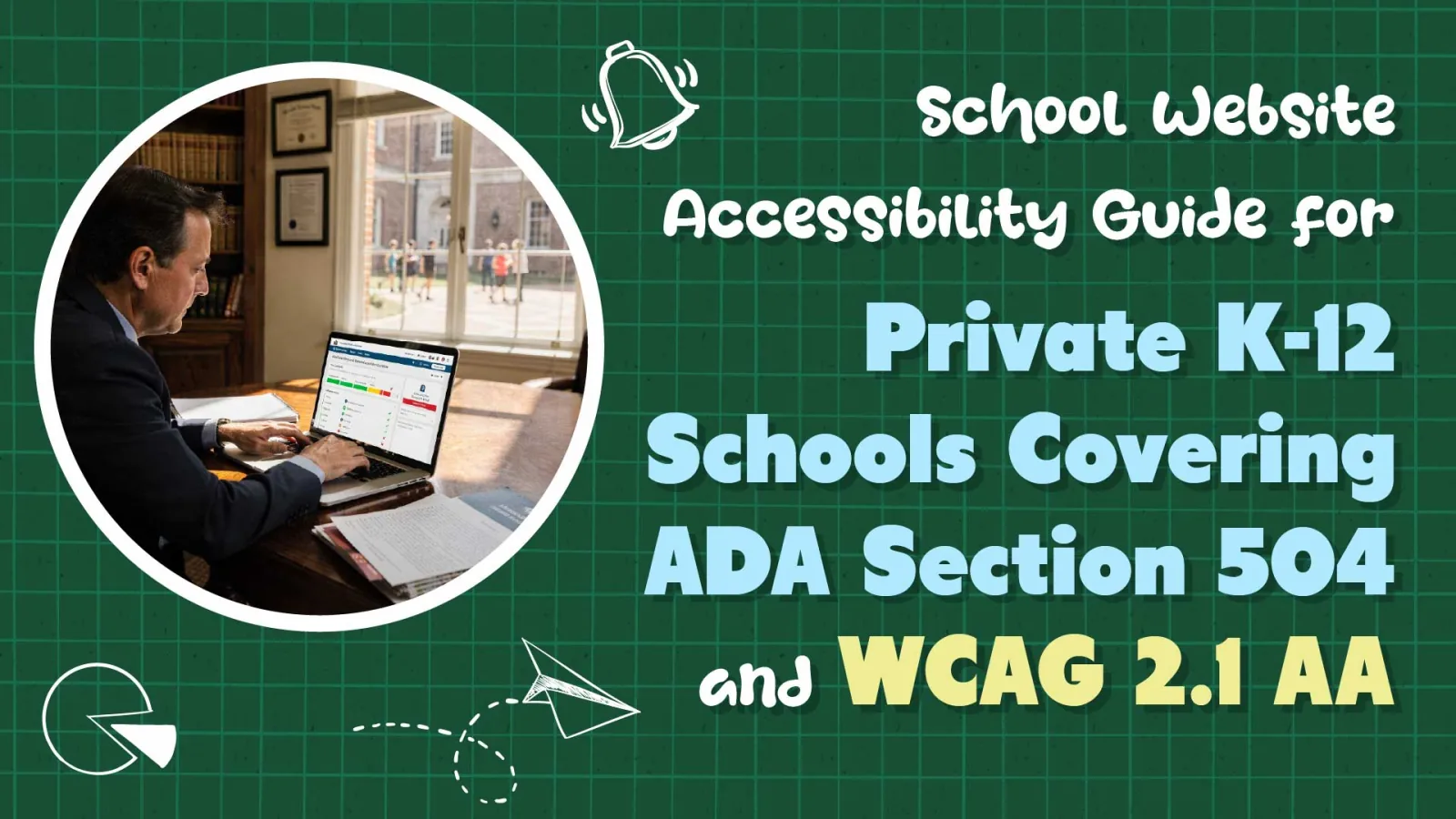
If you are a Head of School running a private K-12 serving 260 students, you are probably not losing sleep over web accessibility. You should be. Web accessibility has moved from an IT footnote to a compliance risk with real teeth, and most private schools are still underinvested. The April 24, 2026 DOJ deadline for Title II entities has raised enforcement visibility across the sector, and legal counsel for independent schools now treat WCAG 2.1 AA as the operational standard for every school website, regardless of religious affiliation or size.
This guide is for a Head of School making decisions about a 260-student college-prep K-12 private school with a marketing budget in the $30,000-$75,000 range. It covers the legal frameworks that actually apply to your school, the technical standards you have to meet, the lawsuits and settlements shaping the enforcement landscape, the audit process, the CMS-specific challenges, the cost of remediation, and the governance model that keeps the site compliant after launch. It is written to give you the analysis you need to talk to counsel, the board, and your marketing and IT teams with confidence.

Written By: Adam Bennett | May 04, 2026
Adam is the president and founder of Cube Creative Design and specializes in private school marketing. Since starting the business in 2005, he has created individual relationships with clients in Western North Carolina and across the United States. He places great value on the needs, expectations, and goals of the client.
If you have ever opened your school's website, read a faculty bio for a teacher who left two years ago, and quietly closed the tab, you already understand why a content audit matters. At faith-based and independent schools, the marketing job usually falls on a principal, an admissions director, or a single communications coordinator. The site drifts. Content piles up. And the next prospective family lands on a page about the 2023 book fair and forms an opinion that is hard to reverse.
This guide is a practical, DIY school website content audit framework for a principal at a K-8 school with 150 to 200 students and a marketing budget in the $25,000-$50,000 range. You do not need a big team or a consultant to run this. You need a spreadsheet, free access to Google Analytics and Google Search Console, an afternoon or two in early summer, and a simple scoring rubric. The result is a clear roadmap that tells you which pages to keep, which to rewrite, which to merge, and which to retire.
Written By: Adam Bennett | May 03, 2026
Adam is the president and founder of Cube Creative Design and specializes in private school marketing. Since starting the business in 2005, he has created individual relationships with clients in Western North Carolina and across the United States. He places great value on the needs, expectations, and goals of the client.
Every April, a Head of School looks at the old website, says "we should redesign this over the summer," and a marketing director quietly considers a career change. A summer website redesign is possible. It is also the single most common project that blows its deadline, budget, or SEO at private and independent schools. The difference between the schools that land a clean July launch and the ones that spend August explaining 404 errors is planning, not hustle.
This checklist is built for a Director of Admissions and Marketing at a mid-sized college-prep school with 400 to 800 students, a marketing budget in the $50,000 to $250,000 range, and a realistic summer window. It covers the audits you run in May, the stakeholder management that keeps the board out of the wireframes, the CMS and budget trade-offs, photography timing, the 301 redirect discipline that protects your SEO, the launch-week QA list, and the 30-60-90-day post-launch priorities. The goal is a website that hits the fall enrollment push with momentum, not apologies.
Written By: Adam Bennett | May 02, 2026
Adam is the president and founder of Cube Creative Design and specializes in private school marketing. Since starting the business in 2005, he has created individual relationships with clients in Western North Carolina and across the United States. He places great value on the needs, expectations, and goals of the client.

Your website is your 24/7 admissions counselor. Right now, it is probably asleep on the job, showing up to the tour in last year's clothes and mumbling about the founding charter while a family with a $35,000 tuition budget quietly clicks away. That is the hard truth most admissions directors at independent schools do not want to hear as they plan summer website projects. The families you want the most are evaluating your school in seven-second increments on an iPhone at 9:47 p.m., and the work your site does in that window decides whether you hit your enrollment targets or spend September apologizing to the Head of School.
This guide is the playbook for rebuilding private school website design into an actual enrollment engine. It covers the current market context, technical performance, parent research behavior, user experience, admissions funnel design, accessibility compliance, CMS trade-offs, and the mistakes that quietly tank inquiry volume. It is written for a specific reader: a Director of Admissions and Marketing at a college-prep school serving 400 to 800 students, with tuition between $18,000 and $35,000 and a marketing budget somewhere between $50,000 and $250,000. If that is not you, most of the principles still apply. If it is, you will recognize yourself in several sections and probably mutter "oh no" at least once.
Written By: Adam Bennett | May 01, 2026
Adam is the president and founder of Cube Creative Design and specializes in private school marketing. Since starting the business in 2005, he has created individual relationships with clients in Western North Carolina and across the United States. He places great value on the needs, expectations, and goals of the client.