July 1 is halftime. The phones have been ringing since the first termite swarm in April, mosquito season is at its peak, and your route board is full enough that it feels like you can finally exhale. Don't. The operators who own the fall didn't start prepping in October. They started building their rodent pipeline in August, and by the time the first homeowner Googled "what's scratching in my walls," their page was already indexed, their reviews were already stacked, and their commercial accounts were already booked through January.
This guide is for independent pest control companies running 5 to 25 technicians who are sitting down for a quarterly review and asking the right question: what do we do for the next 90 days? It's a Q3 planning playbook with budget pacing, regional pest priorities, content timing, review acquisition, commercial moves, and the operational shifts that turn summer momentum into year-round revenue. The independent operator who treats July 1 like halftime, not the fourth quarter, walks into October with a plan instead of panic.

Written By: Chad J. Treadway | June 22, 2026
Chad is a Partner and our Chief Smarketing Officer. He will help you survey your small business needs, educating you on your options before suggesting any solution. Chad is passionate about rural marketing in the United States and North Carolina. He also has several certifications through HubSpot to better assist you with your internet and inbound marketing.

Most school marketing teams are measuring the wrong thing, and the Head of School's quarterly budget review is the moment that mistake finally catches up with them. Click-through rates, social impressions, and form submissions get printed out, tabbed in a folder, and walked into the conference room as proof that the marketing dollars are working. The math has a hole in it big enough to drive an admissions bus through.
Roughly 95 to 97 percent of the families who land on the school's website never fill out anything. They read the tuition page. They scroll through the financial aid FAQ. They open three program pages, compare schedules, and leave. No form, no name, no follow-up, no credit assigned to the channel that brought them in. For private school marketing teams trying to prove ROI to a CFO who already thinks the budget is too big, that missing 95 percent is not a rounding error. It is the entire conversation.
Family identification technology closes that gap, and when it is paired with a serious school marketing attribution framework, it turns a fuzzy "we got a lot of traffic this quarter" report into a defensible ROI story. The rest of this post walks through seven concrete ways that pairing changes what admissions and marketing directors can prove, in a language a board actually understands.

Written By: Adam Bennett | June 22, 2026
Adam is the president and founder of Cube Creative Design and specializes in private school marketing. Since starting the business in 2005, he has created individual relationships with clients in Western North Carolina and across the United States. He places great value on the needs, expectations, and goals of the client.
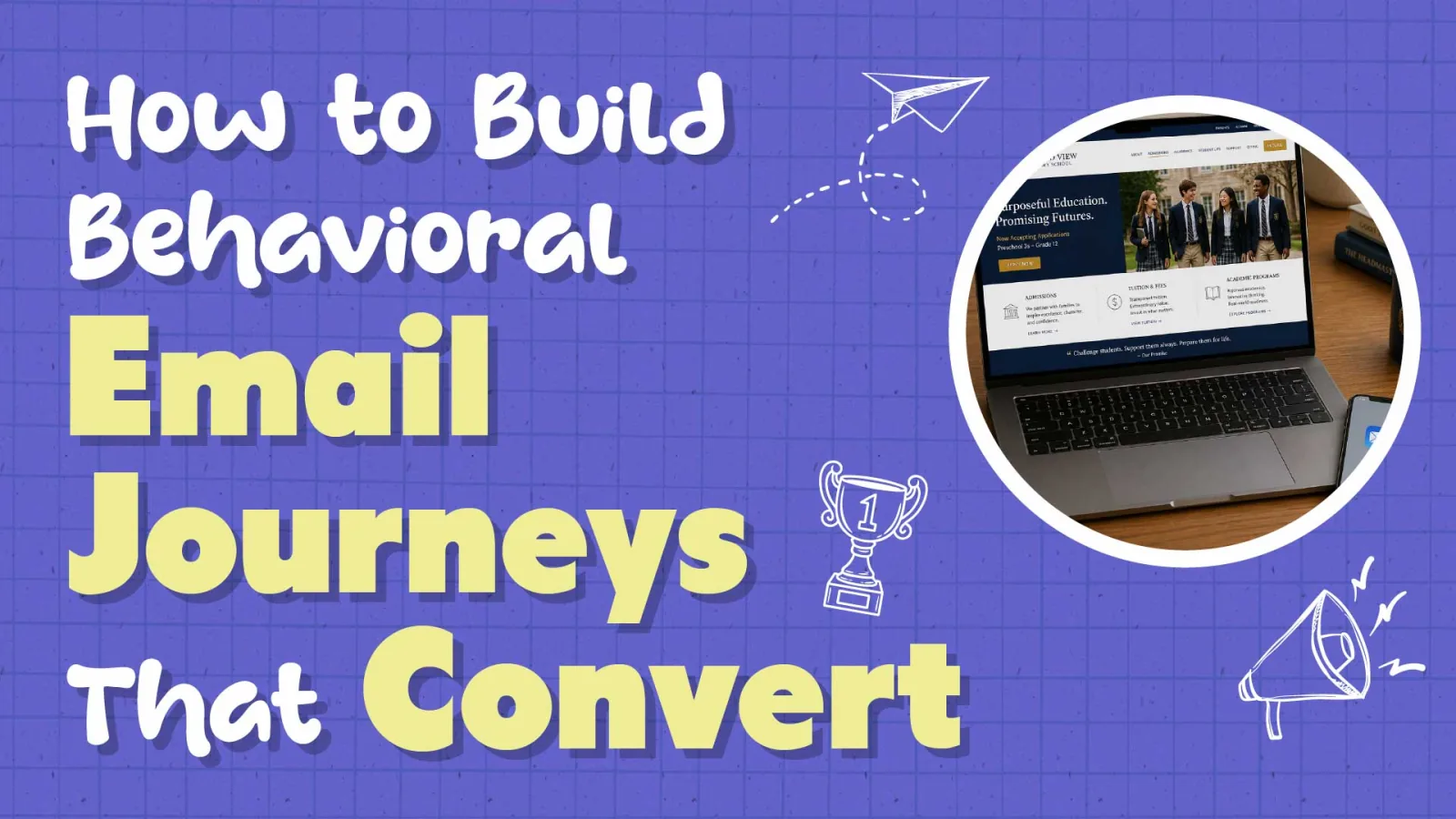
Your enrollment email strategy probably works like this: someone downloads your tuition guide on Tuesday, so your email automation sends them a welcome email on Wednesday. Three days later, a second email. Five days after that, a third.
But here's the problem: that family's real moment of interest might have been Thursday, when they spent 14 minutes on your financial aid page, then clicked through three STEM program profiles. By the time your automated third email lands, they've already moved on.
You're not actually responding to what families are doing. You're guessing when they care.
This is where behavioral triggers change everything. Instead of email timers, you're watching actual family behavior on your website. When a family hits a tuition or financial aid page for the second time in a week, an email arrives within hours; at the exact moment interest is hot. When a visitor clusters around STEM or athletics content, you send a program-specific nurture sequence. When a past prospect suddenly returns to your site, you reach out while they're actively considering your school again.
This approach works for private school marketing because it replaces guesswork with precision. You're not hoping someone is ready. You're responding to evidence that they are.
Written By: Adam Bennett | June 19, 2026
Adam is the president and founder of Cube Creative Design and specializes in private school marketing. Since starting the business in 2005, he has created individual relationships with clients in Western North Carolina and across the United States. He places great value on the needs, expectations, and goals of the client.

If you have been running the same pest control business for fifteen years, you might assume the multiple your neighbor got in 2021 will be waiting whenever you decide to sell. It will not. The market has tightened. The gap between an average $1.5 million pest control company and a premium one is no longer about luck or timing; it is about whether your business survives ninety days of institutional scrutiny without leaking value.
Cube Creative builds the marketing infrastructure that drives recurring revenue, lowers churn, and produces verifiable ROI for independent pest control companies. That same infrastructure shows up on a buyer's diligence checklist. Whether you are one year out or three, the work you do now to clean up revenue mix, software exports, and technician retention compounds into seven-figure differences at close.
This post hands you the same scoring criteria private equity rollups, regional acquirers, and strategic buyers like Rollins, Rentokil, and Anticimex actually use during diligence. Translation, in plain English: what the spreadsheet wizards are looking for, why they are looking for it, and how to plug the gaps before the clock starts.
Written By: Chad J. Treadway | June 18, 2026
Chad is a Partner and our Chief Smarketing Officer. He will help you survey your small business needs, educating you on your options before suggesting any solution. Chad is passionate about rural marketing in the United States and North Carolina. He also has several certifications through HubSpot to better assist you with your internet and inbound marketing.